

Folie a Deux: Shared Paranoia

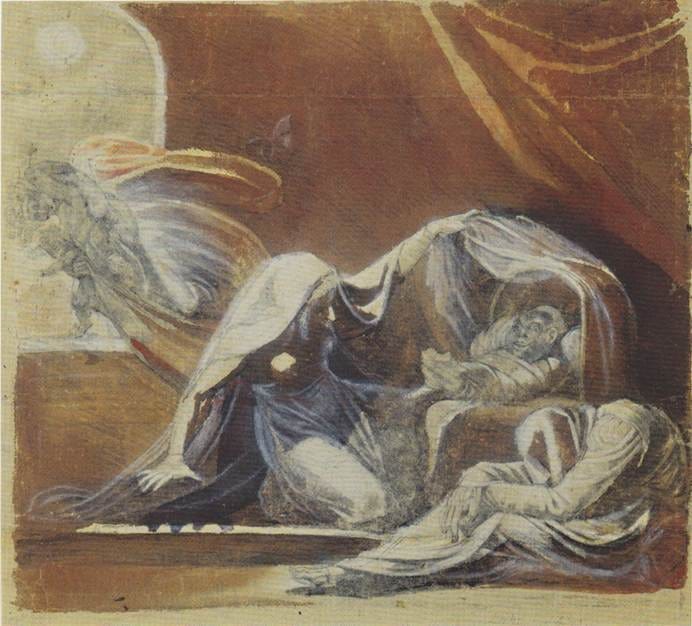
Der Wechselbalg (Changeling) by Henry Fuseli, 1781(Public Domain)

Can a person be found guilty of murder if they were influenced by a psychotic person and trapped in a Folie a Deux shared paranoid delusion? Suffering from a mental illness can be a reason for acquittal of murder, but is Folie a Deux regarded as a mental illness?
Michael Cleary and family 1895
On 15 March 1895, 26-year-old Bridget Cleary was immolated by her husband, Michael who believed she was a changeling and that fairies had abducted his true wife and replaced her. Due to a twist of fate, Michael and Bridget had managed to secure a cottage, reserved for labourers in Ballyvadlea, Ireland, because her father Patrick Boland, a retired labourer, lived with them, but this house was rumoured to have been built at the site of a fairy ringfort, Kylenagranagh Hill. Ringforts are the ruins of prehistoric circular dwellings in Ireland.
Almost two decades before this incident in 1877, French psychiatrists T Charles Lasègue and Jules Falret conceptualized the paranoid delusional disorder, Folie a Deux also known as Lasègue–Falret syndrome. They described a shared psychological disorder in which delusional symptoms are transferred from one psychotic individual to one or more closely associated healthy individuals. When the same syndrome is shared by three it is Folie à Trois (’three’) or Quatre (’four’), shared by a family is referred to as Folie en Famille (’family madness’) and Folie à Plusieurs when many people are involved.
In a case of Folie a Plusieurs, Michael managed to draw Brigid’s father Patrick and her cousins into the paranoid delusion that she was a changeling. Events that led up to this tragedy were Bridget contracting pneumonia and becoming bedridden. Along with her husband and father, her aunt Mary Kennedy and her cousin Johanna Burke tended to her. By 15 March her condition had worsened and a priest arrived to give her the last rites. Michael told him he had no faith in the medicine the doctors had given her. Michael had secretly consulted with Denis Ganey, a fairy doctor who prescribed beestings from a cow. Convinced his wife had been replaced by a changeling, Michael, her father and her cousins conducted a ritual where she was forced to drink the beestings, urine was poured over her, she was dragged to the fireplace and prodded with a red-hot poker. After midnight on 15 March Michael brandished a piece of burning wood before her mouth and demanded that she say her name three times. When she failed to do so he doused her with lamp oil and set her ablaze. Michael and one of the cousins carried her burnt body from the cottage and buried it in a shallow grave. She was found a week later.
Michael Cleary, Patrick Boland, Mary Kennedy, James Kennedy, and Patrick Kennedy were indicted for murder. Other family members were indicted for “wounding”. Michael Cleary was found guilty of manslaughter and sentenced to 20 years of penal servitude; he spent 15 years in prison. Sentences of the others varied from penal servitude to hard labour.
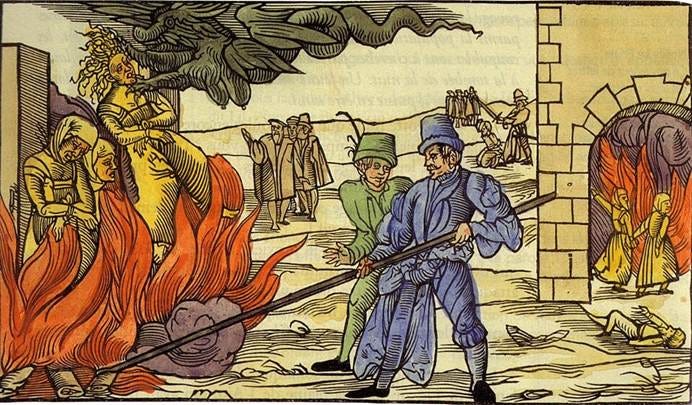

Michael and Susan Carson 1983
About a century later between 1981 and 1983, Michael Bear Carson and Susan Bear Carson were convicted for murdering three people whom they believed were witches in Northern California and the San Francisco Bay Area.
One day, divorced Michael, born James Clifford Carson, informed his daughter in a letter that God had assigned him the name Michael Bear. His second wife, Susan Barnes, became Susan Bear Carson. After Susan had threatened to scratch the devil out of her five-year old stepdaughter, Michael’s first wife took her daughter on the run to hide from the couple.
In March 1981 the body of aspiring actress Karen Barnes was discovered in an apartment basement in San Francisco. She had been stabbed 13 times, and her skull had been crushed. Suspicion fell upon her room mates, Michael and Susan Carson, who had evacuated the premises. By May 1982, the couple lived and worked on a marijuana farm in Alderpoint, California. Michael shot a fellow labourer, Clark Stephens, burnt his body and buried him and the couple were on the run once more. By January 1983 they were hitchhiking near Bakersfield and were given a ride by 30-year-old Jon Charles Hellyar. An argument broke out and Michael shot Charles Hellar in full view of other motorists who called the police. Already on the police’s radar for two murders, the couple were arrested. They confessed to the murders and then retracted the confession.
Here is where the shared paranoid delusion step in. Michael and Susan believed themselves to belong to a special religion, calling themselves Vegetarian Moslem Warriors. Susan had declared Karen Barnes a witch wo deserved to die for renouncing their religion, and for “draining Miss Carson of her health and yogic powers.” Susan declared Stephen Clark a witch for sexually assaulting her and Charles Hellar was a witch, for calling her a witch and sexually abusing her.
They were sentenced 25 years for the murder of Karen Barnes and 50 years to life and 75 years to life for the murders of Stephen Clark and Charles Hellar.
June and Jennifer Gibbons, The Silent Twins 1981
It is interesting that Michael Cleary set his wife on fire, and Michael and Susan Carson burnt the body of Clark Stephens, Fire seems to hold a fascination for those afflicted with paranoid delusional disorder, perhaps subconsciously referring to the Fires of Hell or the Hell Fires of their own conscience, as discussed in previous articles.
In 1981, at the same time when Michael and Susan Carson were running rampage due to their paranoid delusion, the twins June and Jennifer Gibbons were committing arson, vandalism and petty theft, but not murder. Born to Caribbean immigrants, by 1974 the family had settled in Haverfortwest, Wales. The twins by then had developed their own idiosyncratic language, with a Bajan Creole foundation. The twins were ostracised at school, a factor that strengthened their dependence upon each other and their peculiar communication developed into cryptophasia, a language developed by twins that only the two children can understand. It escalated when the twins refused to talk to people at all, and only spoke to each other, and their younger sister. This earned them the moniker The Silent Twins. Attempts at separating them into different boarding schools to encourage communication failed when they became catatonic. They were reunited and isolated themselves in their bedroom, where they enacted elaborate plays. The twins were creating a fantasy world, where they ruled supreme. The twins wrote down these plays about young men and women who exhibit strange and often criminal behaviour. June’s novel titled The Pepsi-Cola Addict, about a high-school boy seduced by a teacher and sent away to a reformatory where a homosexual guard makes a play for him, was eventually published in 2023. Jennifer’s Discomania, about a young woman who discovers that the atmosphere of a local disco incites patrons to insane violence, was published posthumously in 2026 by Penguin Random House.
As teenagers they abused drugs and alcohol and committed the crimes and in 1982 they were subsequently sentenced to indefinite detention to Broadmoor under the Mental Health Act. They were held for 11 years and heavily medicated.
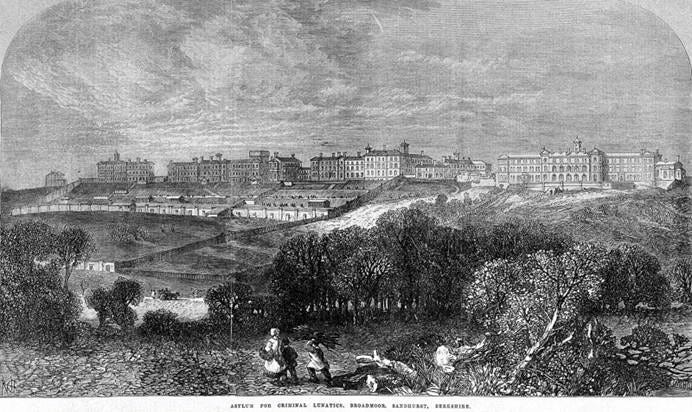

The twins had made a pact that if one should die, the other would continue living and start talking. The shared delusion steps in when they decided that Jennifer should sacrifice herself and die. In March 1993, during their transfer from Broadmoor to the more open Caswell Clinic in Bridgend, Wales, Jennifer slept with her head in June’s lap in the ambulance. Upon their arrival at Caswell Jennifer had fallen into a stupor. She was taken to the hospital, where she died soon after of acute myocarditis. There were no drugs or poison in her system. For the first time, June spoke up. She said: “I’m free at last, liberated, and at last Jennifer has given up her life for me.” She described the experience as a tsunami, washing her of her sins and being free of her sister.
By 2008, June was living quietly and independently, near her parents in West Wales. She was no longer monitored by psychiatric services. In 2023, June explained as children they had in fact been speaking English, but others had mistaken it for an invented language due to the severity of their speech impediment. They stopped talking because they feared people misunderstood them.
Elizabeth Haysom and Jens Soering 1985
Whilst June and Jennifer were at Broadmoor in 1986, the consultant forensic psychiatrist, Dr Hamilton wrote a report where he diagnosed an 18-year-old man with Folie a Deux.
In 1984, 20-year-old Elizabeth Haysom, met German-born 18-year-old Jens Soering, at an orientation event at the University of Virginia and they fell in love. The next year Jens brutally murdered Elizabeth’s parents, Derick and Nancy Haysom, due to Elizabeth’s allegations of mistreatment by her parents and Jens fearing that the parents would break them up. Six months after the murder, the couple fled to England where they assumed false names and committed a series of fraud. They were arrested and during the interrogation, Jens confessed to the murder. Dr Hamilton assessed Jens and found him to be trapped in a Folie a Deux situation, and not responsible for the crime, but was this enough to get Jens off on a murder charge?
How do these case studies fit the profile of Folie a Deux?