

Profiling Lusty Witches

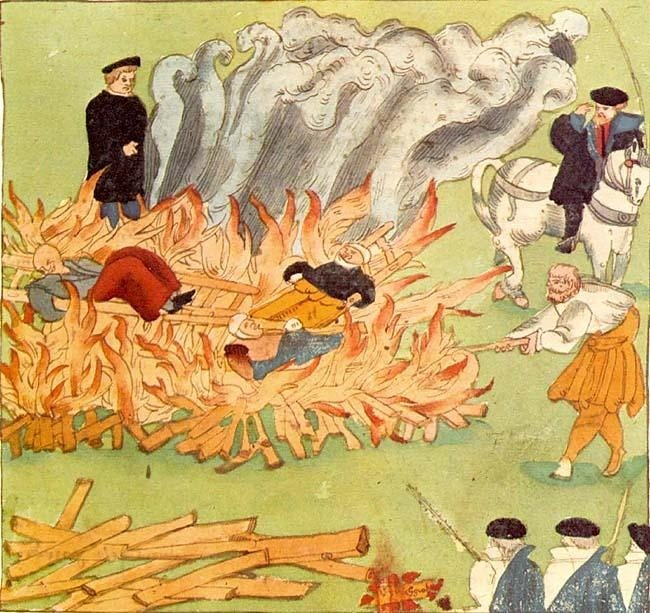

In Medieval Europe, heretics and witches were deemed criminals and burnt alive at the stake. In 1484 German Catholic clergyman Heinrich Kramer made one of the first attempts at prosecuting alleged witches in the Tyrol region. It was not a success and he was expelled from the city of Innsbruck and dismissed by the local bishop as “senile and crazy”. In an act of self-justification, he wrote The Malleus Maleficarum, (the Hammer of Witches) a treatise about witchcraft,
The book can be regarded as an early attempt at profiling. The profile of a witch was: Usually a female – of the weaker sex, but with a strong personality; they have a “temperament towards flux” and “loose tongues”; they “are defective in all the powers of both soul and body” and are stated to be more lustful than men. Men could be witches, but were considered rarer. The most common form of male witch mentioned in the book is the sorcerer-archer. The main difference between a male and a female witch is a male is motivated by power and a female by lust.


Heinrich Kramer was described by the local bishop Golser as a ‘demented senile old man’. Would this be a profile or a diagnoses and what is the difference?
Differences and similarities between profiling and diagnoses:
A medical diagnoses is a cluster of symptoms pointing to a category of mental illness, aimed at the treatment of the person. To comply with international standardization, current medical practitioners and clinicians usually refer to the Diagnostic Statistical Manual (DSM V) or the ICD 11 to review the specific clusters and requirements to make a medical diagnosis. In this case it is necessary for the clinician to personally interview and assess the patient. Only a clinician with a medical or para-medical qualification such as psychologist, psychiatrists or physician can diagnose a mental illness.
Personality disorders are not mental illnesses. There are several personality disorders, of which anti-social (psychopath), narcissistic, histrionic are the most well-known. They are classified under Axis II on the DSM V, where they are defined as an enduring pattern of inner experience and behaviour that deviates markedly from the general expectations of the individual’s culture, It is deeply ingrained, pervasive and inflexible and has an onset in adolescence or early adulthood and leads to distress or impairment.” There is no cure or medication for a personality disorder. A mental illness is a sickness a person is suffering from, while a personality disorder is who that person is.
In short, the two main differences between diagnoses and profiling are: A medical diagnoses is aimed at treatment and medication of a known person, whom a clinician has personally assessed. There is a doctor-patient relationship. A profile is aimed at providing a psychological portrait of a known or unknown subject, without the profiler having met that person and that person may, or may not be a criminal. A profile describes how a person manifests their personality traits through their observable behaviour. A crime scene may be regarded as a manifestation or end-result of a person’s behaviour revealing personality traits, but so can a book or manifesto they wrote be a manifestation of their behaviour, revealing personality traits, to the trained observer.
The profile may include predictions of personality disorders and mental disorders, but there is no doctor-patient relationship between the profiler and the subject. One can profile a deceased historical person.
Categories of Profiles
Modern offender profiling originated at the FBI’s Behavioural Sciences Institute in the late 1970’s. Three of the first generation profilers were special agents Robert Ressler, Roy Hazelwood and John Douglas. I was trained by both Mr Robert Ressler and Mr Roy Hazelwood in the early 1990’s in Dundee, Scotland. Since they were employed by the FBI, naturally their profiles focussed on offenders. They defined profiling as the process of identifying the psychological characteristics of an individual and forming a description of their personality based on an analysis of crimes they have committed. Soon documentaries, movies and television series brought offender profiling into the spotlight and the public formed a perception that profiling is only used in a criminal investigation, to describe an offender. However, as I explained, profiling does not always pertain to identifying an unknown perpetrator of criminal behaviour. It has since evolved to constructing a psychological portrait of a known subject in order to predict the behaviour or personality of that person and adjust one’s dealings with them accordingly.
Intelligence profiling is when information is gathered about a specific identified subject, in order to recruit them, for instance into a covert agency and to influence them. It can also pertain to recruiting a certain person for a position in a business, or profiling a CEO or politician before a negotiation.
Forensic profiling is when a profile is compiled of a subject for court purposes to assist prosecutors, defence barristers and the judge in understanding the motivations and behaviour of that person. Behavioural patterns and characteristics can point to a certain personality type, with the aim to predict behaviour, and explain the behaviour and motivation of the subject to the court. Since this is not a medical diagnoses, it is not necessary for the profiler to personally assess the subject. Of course certain characteristics of the personality types can overlap with medical diagnoses, but the aim is not the medical treatment of a patient. The conclusions are based upon evidence, first-hand testimonies and the behaviour on record of the subject. The profile can refer to personality types, but it is not a diagnoses. Forensic profiling also pertains to child custody cases, but in this case the participants- usually the parents and the children – are interviewed and assessed through psychometrics by a psychologist or social worker, but this is not a doctor-patient confidential relationship. Again. the aim is to assist the court in understanding the subjects better, not to treat them.
Sources for profiling could be anything the subject produced – letters, contents of communications, drawings, social media postings; even first-hand accounts of someone who has dealt with the subject. Certain behavioural patterns or habits, can be a source, for example a meticulously fastidious person may have an anal personality. Leadership styles, taste, clothing style, display of wealth or even keeping a low profile under the radar, can all tell a story of a person. Profiling is like baking a cake, the more ingredients, the fancier the cake is going to be. A good profiler does not only focus on the obvious observable variants, but digs deeper into the subconscious motivations of the subject, like attachment bonding during childhood, trauma and psychological defence mechanisms, which is why a basic foundation of psychology is preferred for effective profiling.
Dark Personality Tetrad
In 2002 psychologists Drs Delroy Paulhaus and Kevin Williams published the theory of the Dark Personality Triad, which describes three notably offensive but non-pathological personality types: Machiavellianism, sub-clinical Narcissism, and sub-clinical Psychopathy. It was expanded in 2013 to the Dark personality Tetrad, to include sadism.
Machiavellian Personality Type: This element of the tetrad focusses on the master manipulation tactics deployed by the individual, in order to be in control at all costs, as well as retaliation and revenge strategies to eliminate their opponents.
Psychopathic Personality Type: This element of the tetrad focusses on ruthlessness, self-interest, a lack of conscience and lack of empathy for other people.
Narcissistic Personality Type: This element of the tetrad focusses on being the centre of attention, an attitude of entitlement and exaggerated self-esteem, superficial charm and showcasing status and public acclaim.
Sadistic Personality Type: This element of the tetrad focusses on deriving pleasure from the physical and psychological torture of victims.

Profile: Heinrich Kramer
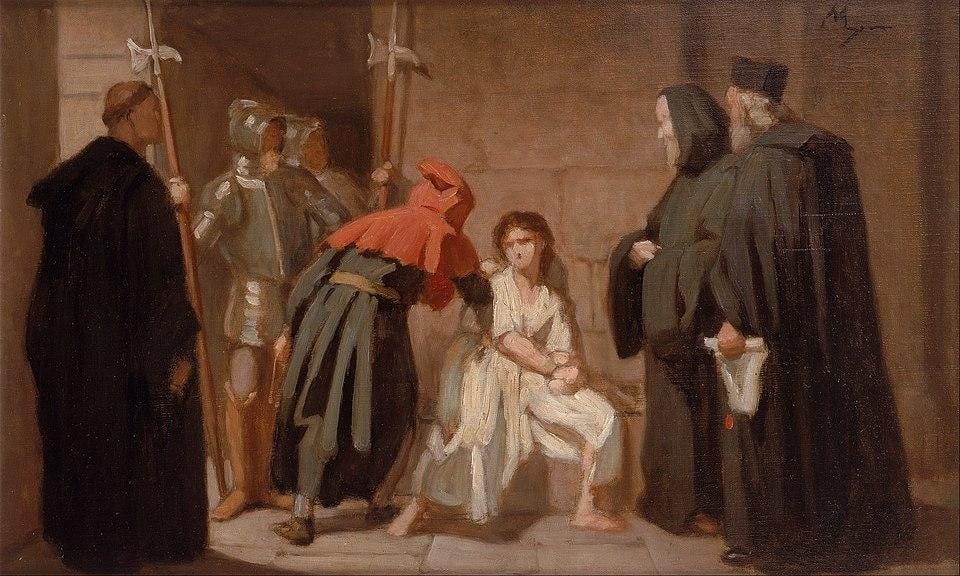
Heinrich Kramer (1430 – 1505) joined the Dominican Order and at around 40 years of age, he was appointed Inquisitor for the Tyrol, Salzburg, Bohemia and Moravia region. At Innsbruck he headed an inquisitorial commission with the stated intention of “bringing witches to justice”. Here he met his nemesis, Helena Scheuberin, married to a prosperous burgher. Helena opposed the witch-hunting deomonologist doctrine and was not shy to speak out against it. On passing Kramer in the street, she spat and cursed him publicly: “Fie on you, you bad monk, may the falling evil take you“. This must have flagged Kramer’s fragile ego. When she further encouraged people not to attend his sermons “by loudly proclaiming that she believed Institor to be an evil man in league with the devil“, Helena had just volunteered herself as a witch, in Kramer’s estimation, who had her and six other people arrested and charged with witchcraft.
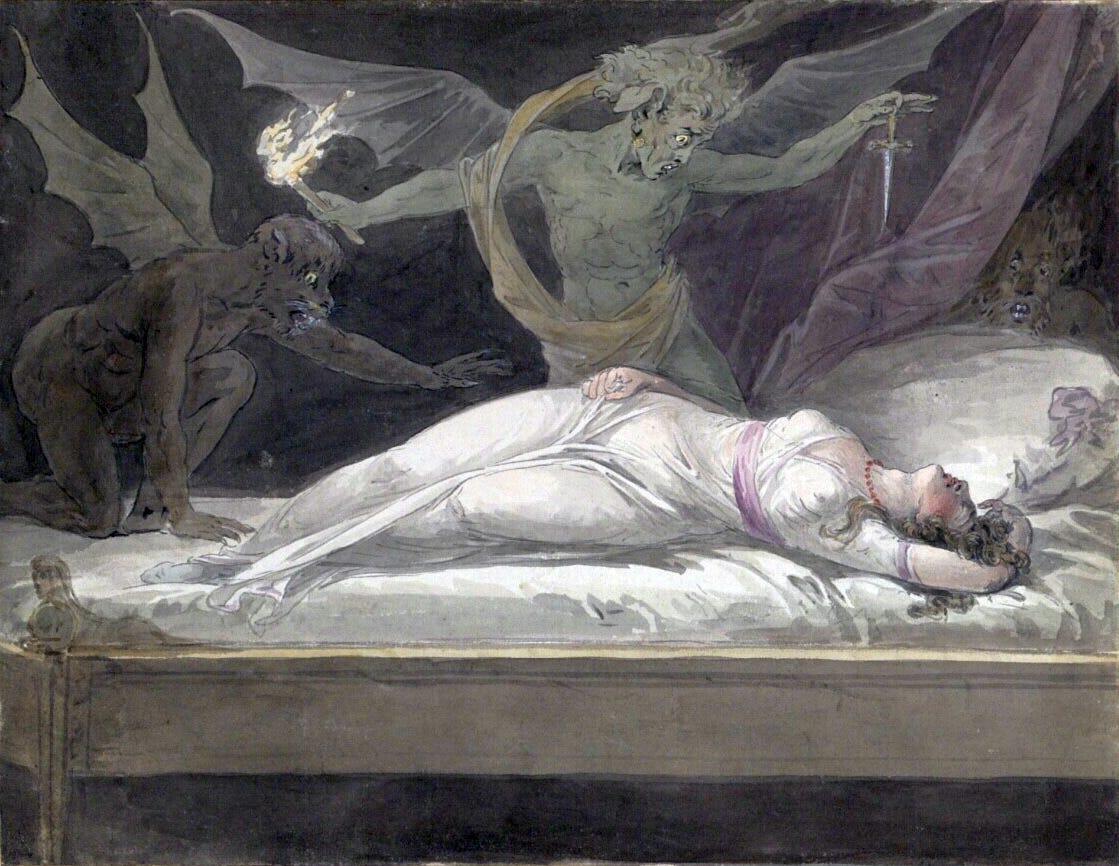
During her trial Kramer became obsessed with Helena’s sexuality, even questioning whether she was a virgin when she got married. To Kramer, witches were lustful beings, and had the power ‘to steal a man’s penis’. They also performed “filthy carnal acts with demons” and incubi - male demons who seduced women in their dreams, leading to vaginal ejaculation discharge for the incubi to survive. One can clearly see where Kramer’s own lustful fantasies led him, but typically he projected this shadowself onto his chosen target.

Regarding the punishment of witches Kramer wrote:
“And when the implements of torture have been prepared, the judge, both in person and through other good men zealous in the faith, tries to persuade the prisoner to confess the truth freely; but, if he will not confess, he bid attendants make the prisoner fast to the strappado or some other implement of torture. The attendants obey forthwith, yet with feigned agitation…”But, if the prisoner will not confess the truth satisfactorily, other sorts of tortures must be placed before him, with the statement that unless he will confess the truth, he must endure these also. But, if not even thus he can be brought into terror and to the truth, then the next day or the next but one is to be set for a continuation of the tortures – not a repetition, for it must not be repeated unless new evidences produced. The judge must then address to the prisoners the following sentence: We, the judge, etc., do assign to you, such and such a day for the continuation of the tortures, that from your own mouth the truth may be heard, and that the whole may be recorded by the notary.”
In 1486, Kramer’s obsession finally led to Bishop Golser ordering him to leave his diocese. The trials in Innsbruck were finally suspended and Helena Scheuberin was acquitted.
Probably Heinrich Kramer can be profiled with an Obsessive-Compulsive Personality Disorder, characterized by an extreme, rigid, and inflexible preoccupation with orderliness, perfectionism, and interpersonal control, with an underlying misogynistic belief system and sadistic fantasies. He probably had a fixation during Freud’s anal psychosexual developmental phase at the age of 2 – 4 years. Just for good measure narcissism, projection as a defence mechanism and psychopathic tendencies can be thrown in. In today’s time, it would not be difficult to profile Kramer as a Dark Personality Tetrad.